
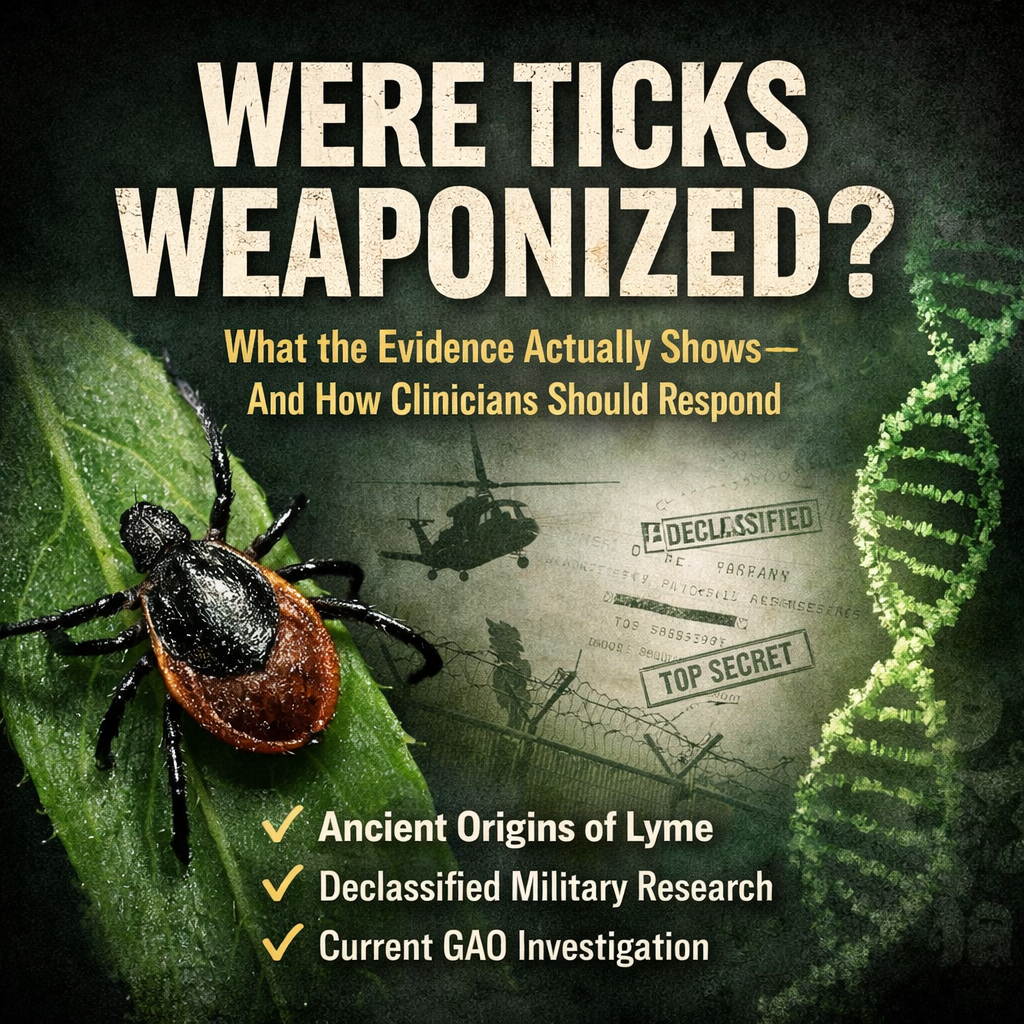
What the Evidence Actually Shows—and How Clinicians Should Respond
Your patients are asking about weaponized ticks.
The headlines are everywhere. Social media is full of claims that Lyme disease was engineered as a government bioweapon. Conspiracy theories are spreading faster than the ticks themselves.
And whether we like it or not, these narratives are now walking into exam rooms.
Just this week, the U.S. Department of Health and Human Services (HHS) held a major Lyme disease roundtable, publicly emphasizing the need for improved diagnostics and better clinical tools. Regardless of political leanings, that matters—the national conversation is shifting toward earlier detection, clearer differentiation, and approaches that better match the complexity clinicians actually see.
At the same time, patients are arriving with fear-based questions:
- Was Lyme disease created in a lab?
- Did the government weaponize ticks?
- Am I sick because of something hidden or covered up?
Here’s the clinical challenge:
Dismissing these concerns erodes trust.
Validating unsupported conspiracy theories does the same.
The middle ground—and the only ground that truly serves patients—is evidence.
I’ve spent years treating complex Lyme and tick-borne illness and training clinicians how to manage cases that don’t respond to standard approaches. In the last week alone, multiple providers asked me how to handle the “weaponized tick” question without alienating patients or amplifying misinformation.
So let’s address this clearly, calmly, and scientifically.
By the end of this article, you’ll understand:
- What genomic evidence actually shows about the origins of Lyme disease
- What historical military research did—and did not—involve
- What the current government investigation really means
- And how to respond to these questions in practice while maintaining trust and focus
Lyme Disease Is Ancient—Not New, Not Engineered
Every conspiracy theory about weaponized Lyme relies on one assumption:
That Lyme disease is new.
If Lyme were created in the 1970s, the theory might hold water.
But it isn’t. And it wasn’t.
Direct Human Evidence: 5,300 Years Old
In 1991, hikers in the Alps discovered a naturally preserved frozen mummy—Ötzi the Iceman. He lived more than 5,300 years ago, long before modern medicine, modern warfare, or modern laboratories.
When researchers later sequenced his DNA, they identified genetic material consistent with Borrelia burgdorferi infection.
That is direct human evidence of Lyme disease more than five millennia ago.
Genomic Evidence: At Least 60,000 Years Old
Modern genomic reconstructions tell an even deeper story.
Multiple evolutionary analyses show that Borrelia burgdorferi has circulated within North American ecosystems for tens of thousands of years, commonly estimated at 60,000 years or more—long before modern humans arrived on the continent.
The organism predates civilization. It predates agriculture. It predates governments.
So what is new?
- Recognition of Lyme as a clinical entity
- Diagnostic tools capable of identifying it
- Ecological changes that increased human–tick contact
Lyme disease wasn’t “created” in Lyme, Connecticut in the 1970s. It was recognized there—at a time when suburban expansion, changing land use, and improved diagnostics converged.
This distinction matters. Because once you understand the timeline, the idea of a modern laboratory origin collapses under the weight of genomic reality.
What Military Research Actually Involved (And What It Didn’t)
Now for the part that is often misrepresented.
Yes—there was U.S. military research involving insects.
That’s not conspiracy. It’s historical fact.
But context matters.
Entomological Warfare ≠ Creating Lyme Disease
Declassified documents, including those released by The Black Vault, describe Cold War–era programs such as Operation Big Itch, which explored whether insects could theoretically be dispersed as vectors.
Here’s the critical detail:
These tests used uninfected insects.
The research focused on delivery feasibility, not on engineering or deploying pathogens.
There is an enormous difference between:
- Studying whether insects can be dispersed
- And creating, modifying, or weaponizing a specific organism
The historical record supports the former—not the latter.
Policy Shifts Matter
- 1969: President Nixon formally renounced U.S. offensive biological weapons research
- 1975: The Biological Weapons Convention entered into force, prohibiting development and stockpiling of biological weapons
Lyme disease was clinically described in 1975—after these restrictions were already in place.
More importantly, none of this changes the genomic reality:
An organism that has existed for 60,000+ years cannot have been invented in the 20th century.
The GAO Investigation: What It Does—and Doesn’t—Mean
You may have heard that Congress has directed the Government Accountability Office (GAO) to investigate historical claims about Lyme disease and potential government involvement.
That’s true.
But here’s what that actually means:
An investigation directive is not evidence.
It simply means the GAO has been asked to review historical records and report what they find.
This does not validate weaponization theories.
It does not disprove them either.
It means: look at the documents and report back.
When patients bring this up, the most accurate response is also the calmest one:
“Yes, there’s an investigation underway. We’ll see what the findings show. In the meantime, let’s focus on what we know helps patients get better.”
In my experience, sensational headlines almost never reflect the nuanced reality of the evidence. The final report—not the speculation—will be what matters. And likely raise more questions than answers. But it’s a great next step…and all stakeholders have been invited to the table, which is a huge leap forward.
How to Handle These Conversations in Practice
This is where clinical skill meets communication strategy.
Here’s a simple, effective three-step approach that preserves trust and keeps care moving forward.
1. Validate the concern
“I understand why these headlines are concerning. A lot of people are asking about this.”
2. Present the evidence briefly
“The genomic evidence shows Borrelia is ancient—we have direct human evidence going back 5,300 years and evolutionary evidence suggesting it’s been in North America for over 60,000 years. The scientific consensus is that it’s naturally occurring, not manufactured.”
3. Redirect to what’s actionable
“What matters most for your case is accurate diagnosis and effective treatment. Let’s focus on what we can do to help you improve.”
You’re not debating.
You’re not dismissing.
You’re demonstrating grounded, evidence-based leadership.
That builds trust—and trust is what allows patients to engage fully in complex treatment plans.
Tick-Borne Illness Is Bigger Than Lyme
One final reminder:
Tick-borne illness is not just Lyme disease.
Babesiosis, Bartonella, and other co-infections are expanding beyond historical hotspots as tick ranges increase.
Babesia in particular is frequently missed—presenting with fatigue, sweats, air hunger, head pressure, bone pain and non-specific symptoms that don’t resolve with Lyme-focused treatment alone.
This clinical reality matters far more than any conspiracy theory.
And this is where the field is genuinely advancing.
New diagnostic technologies—AI-enabled assays, droplet digital PCR, and molecular tests capable of detecting active infection with remarkable sensitivity—are changing what’s possible. These tools are what will ultimately improve outcomes for patients who’ve gone years without answers.
The Bottom Line
Your patients are asking about weaponized ticks because fear-driven headlines are everywhere.
Now you have grounded, evidence-based talking points:
- Borrelia burgdorferi is ancient—5,300 years of human evidence, 60,000+ years of evolutionary evidence
- Military research into insects focused on dispersal methods using uninfected insects, not pathogen creation
- The GAO investigation is a review—not proof of wrongdoing (More to come!)
- The clinical priority remains accurate diagnosis, co-infection awareness, and effective treatment sequencing
The conspiracy theories will fade.
The clinical need will not.
The providers who master these complexities—who can confidently diagnose Babesia when others miss it, interpret nuanced labs, and sequence treatment appropriately—are the ones truly changing patient outcomes.
(This level of clinical mastery doesn’t come from protocols alone.)
Focus on mastery.
Focus on evidence.
Focus on what works.
For clinicians who want to go deeper
If this article resonates, it’s likely because you’re already seeing how complex tick-borne illness really is—diagnostically, immunologically, and relationally.
The Lyme Disease Practitioner Certification (LDPC) was created for clinicians who want more than protocols:
- Clear diagnostic reasoning across Lyme, Babesia, Bartonella, mold, and neuroimmune overlap
- Confidence navigating gray-zone labs and non-linear responses
- A clinical framework that matches the complexity you see in real patients
If you’re interested in learning more, you can explore the program here.
(No pressure—just clarity.)
References
- Walter KS, Carpi G, Caccone A, Diuk-Wasser MA. Genomic insights into the ancient spread of Lyme disease across North America. Nat Ecol Evol. 2017;1(10):1569-1576. doi:10.1038/s41559-017-0282-8
Key finding: Explicitly states B. burgdorferi diversity is “ancient (~60,000 years old)” based on molecular clock analysis, though notes “substantial uncertainty in estimated divergence times”; recent Lyme emergence reflects ecological change, not bacterial evolution
- Hoen AG, Margos G, Bent SJ, et al. Phylogeography of Borrelia burgdorferi in the eastern United States reflects multiple independent Lyme disease emergence events. Proc Natl Acad Sci U S A. 2009;106(35):15013-15018. doi:10.1073/pnas.0903810106
Key finding: B. burgdorferi was present in North America “many thousands of years before European settlements”; populations reemerged independently from separate relict foci persisting since precolonial times
- Keller A, Graefen A, Ball M, et al. New insights into the Tyrolean Iceman’s origin and phenotype as inferred by whole-genome sequencing. Nat Commun. 2012;3:698. doi:10.1038/ncomms1701
Key finding: Identified Borrelia burgdorferi DNA in Ötzi the Iceman (5,300 years old); sequences corresponding to ~60% of B. burgdorferi genome described as “indicative of the earliest human case of infection with the pathogen for Lyme borreliosis”
- Steere AC, Malawista SE, Hardin JA, et al. Erythema chronicum migrans and Lyme arthritis: the enlarging clinical spectrum. Ann Intern Med. 1977;86(6):685-698. doi:10.7326/0003-4819-86-6-685
Key finding: Erythema chronicum migrans (an expanding skin lesion) and Lyme arthritis represent manifestations of a single disease entity, with the skin lesion often preceding arthritis by weeks to months and serving as the diagnostic marker of the illness.
- Burgdorfer W, Barbour AG, Hayes SF, Benach JL, Grunwaldt E, Davis JP. Lyme disease—a tick-borne spirochetosis? Science. 1982;216(4552):1317-1319. doi:10.1126/science.7043737
Key finding: Discovery and characterization of the Lyme disease spirochete
- Krause PJ, Auwaerter PG, Bannuru RR, et al. Clinical practice guidelines by the Infectious Diseases Society of America (IDSA): 2020 guideline on diagnosis and management of babesiosis. Clin Infect Dis. 2021;72(2):e49-e64. doi:10.1093/cid/ciaa1216
Key finding:: Co-infection awareness and expanding tick-borne disease risk
- Qiu WG, Dykhuizen DE, Acosta MS, Luft BJ. Geographic uniformity of the Lyme disease spirochete (Borrelia burgdorferi) and its shared history with tick vector (Ixodes scapularis) in the northeastern United States. Genetics. 2002;160(3):833-849. doi:10.1093/genetics/160.3.833
Key finding: Both Borrelia and I. scapularis populations show characteristics of recent expansion from population bottleneck; last glacial maximum (18,000 years ago) likely caused observed “founder effects”