
But Here’s What That Number Actually Means
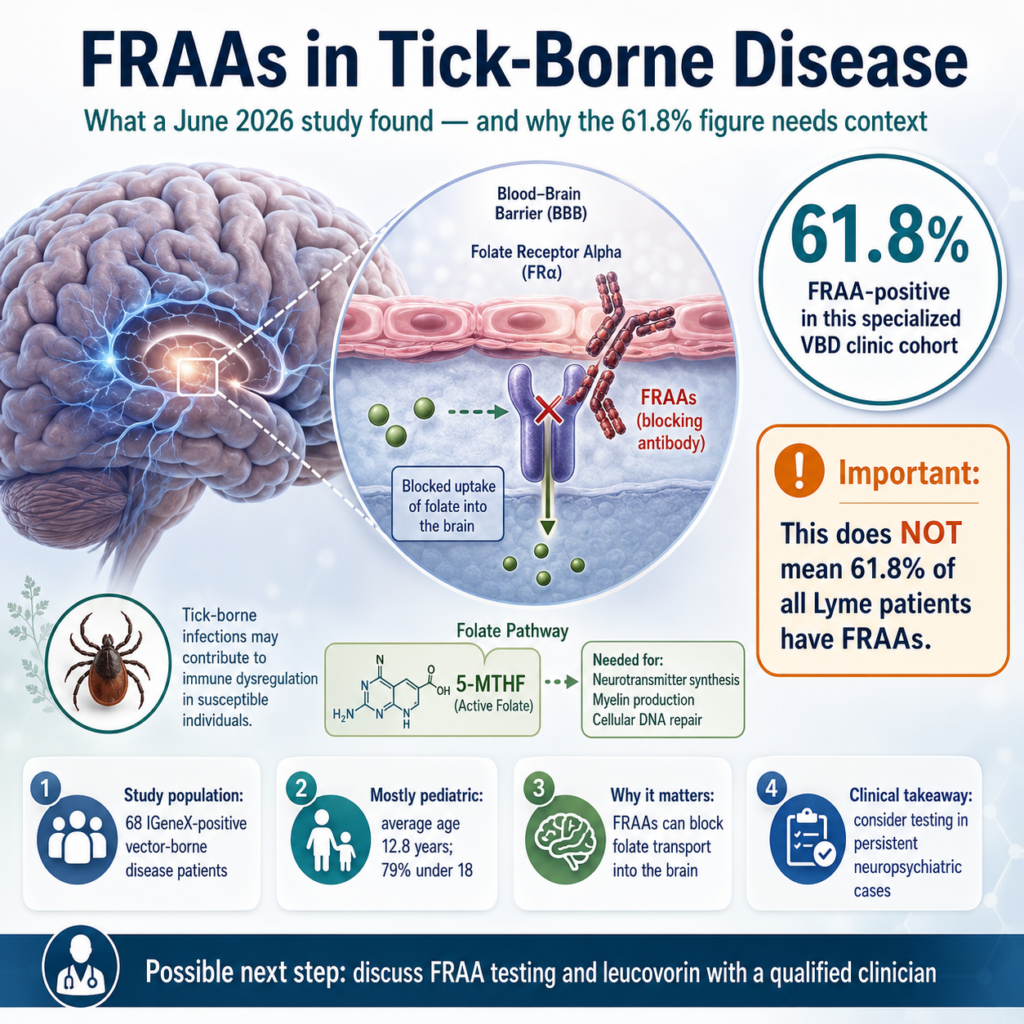
The short version: A June 2026 study found that 61.8% of patients at a specialized tick-borne disease clinic tested positive for folate receptor alpha autoantibodies (FRAAs) — antibodies that block the brain’s ability to absorb folate. That’s a striking number. It’s also a number that needs context before you run with it.
This study doesn’t mean 61% of all Lyme disease patients have FRAAs. What it does mean is that among patients with tick-borne diseases who are already struggling neuropsychiatrically — anxious, obsessive, fogged, depressed, not responding to antibiotics the way you’d hope — FRAAs appear often enough that testing for them should become routine. And if they’re found, there’s a real treatment option most practitioners aren’t using yet.
That’s worth understanding carefully.
In This Article You’ll Learn
- What folate receptor alpha autoantibodies (FRAAs) are — and how they can quietly starve your brain of folate even when your blood levels look completely normal
- What the new research actually found — the real numbers, the confidence intervals, and why the 61.8% figure is more nuanced than any headline will tell you
- Why you can’t identify FRAA-positive patients by symptoms alone — and what that means for who should be tested
- The Borrelia-specific finding that suggests spirochetal infection may trigger a distinct form of folate receptor autoimmunity
- How Lyme disease disrupts the blood-brain barrier and why that creates the conditions for autoimmunity to develop
- What leucovorin is, how it bypasses the blocked receptor, and what the evidence shows in related neuropsychiatric conditions
- What a properly designed follow-up study would need to look like — including sample size, and why this one can’t answer those questions yet
- Specific questions to bring to your doctor if you or your child has tick-borne disease and unresolved neuropsychiatric symptoms
What Is This Study, and Who Did It?
The research was published June 5, 2026 in the peer-reviewed journal Diseases under the title “Folate Receptor Alpha Autoantibodies in Vector-Borne Disease Populations.” It was led by Lindsey Wells, ND, a naturopathic physician practicing in Wilton and Trumbull, Connecticut, with co-authors including Dr. Richard E. Frye — one of the most rigorous researchers working in the FRAA space — from the Autism Discovery and Treatment Foundation.
The study looked at 68 patients who tested positive for vector-borne diseases (Lyme disease, Bartonella, Babesia, and tick-borne relapsing fever) using IGeneX laboratory testing. The cohort was predominantly pediatric — average age 12.8 years, 79% under 18. All patients were evaluated at a single clinical practice.
This is the first study ever to look at FRAA prevalence in a VBD population. That alone gives it significance, independent of sample size.
What Are FRAAs, and Why Do They Matter to the Brain?
Folate receptor alpha (FRα) is the protein your body uses to transport the active form of folate — 5-methyltetrahydrofolate (5-MTHF) — across the blood-brain barrier. Under normal conditions, FRα picks up folate from the bloodstream and shuttles it into the brain. When the immune system produces antibodies against FRα, those antibodies can either block the folate-binding site directly or bind to other regions of the receptor and interfere with its function.
The result is cerebral folate deficiency (CFD): below-normal folate levels in the cerebrospinal fluid, even when blood folate looks completely normal on standard testing. A standard folate blood test won’t catch this. You need the FRAA-specific assay.
CFD caused by FRAAs is already documented across several serious neuropsychiatric conditions. Research has found FRAAs in 83.5% of patients with refractory schizophrenia, in 36% of patients with treatment-resistant depression, in 9 of 16 TRD patients in one targeted study, and in 63.8% of PANS/PANDAS patients. In autism spectrum disorder, FRAA positivity has been associated with meaningful clinical improvement when treated with leucovorin.
What this new study asks — for the first time — is whether tick-borne infections belong in that same category. The answer appears to be yes, with important caveats.
What Did the Study Actually Find?
61.8% of VBD-positive patients had detectable FRAAs (95% CI: 49.9–72.4%). The general population background rate is estimated at 5–15%. That’s not a small elevation. Even at the lower bound of the confidence interval — 49.9% — you’re still looking at a rate three to ten times higher than baseline.
11.8% had a soluble folate receptor (sFR) — a circulating folate-binding protein that doesn’t transport folate into cells and can actually sequester it in the bloodstream, compounding the problem. Of those 8 sFR-positive patients, 87.5% had confirmed Borrelia species infection. That clustering is biologically striking and suggests Borrelia may do something specific to folate receptor biology that the other co-infections don’t.
FRAA-positive patients were three times more likely to carry a PANS/PANDAS diagnosis than FRAA-negative patients (57.1% vs. 30.8%; OR = 3.00; 95% CI: 1.07–8.43; p = 0.046). That statistical association, in a cohort this size, is clinically meaningful even if it sits near the significance threshold.
So Why Can’t We Take the 61.8% at Face Value?
Because of who was in the study.
These 68 patients didn’t represent a random cross-section of tick-borne disease. They were patients who sought out a specialized naturopathic practice, many of them because they weren’t getting better with conventional treatment. Persistent neuropsychiatric symptoms — anxiety, OCD, mood instability, cognitive dysfunction — were exactly what characterized this population. The study authors explicitly acknowledge this.
This is called selection bias, and it matters enormously. The true FRAA prevalence across the entire population of Lyme disease patients — including the many who recover uneventfully with standard antibiotics and never see a specialist — is almost certainly lower than 61.8%.
How much lower? We genuinely don’t know. There’s no population-based study. There’s no large multi-site prevalence study. There’s not even a good control group in this paper (the authors compare their results to published general-population rates, which is reasonable given the limitations, but it’s not the same as a matched control cohort).
What we can say with confidence: in patients who look like the ones in this study — tick-borne disease confirmed, neuropsychiatric symptoms present, not fully responding to antimicrobials — FRAAs appear to be common. Common enough that not testing for them is a missed opportunity.
Why Would Lyme Disease Trigger Folate Receptor Autoimmunity?
The honest answer is: we have plausible mechanisms, but the causal chain is unproven.
Here’s what we do know. After tick inoculation, Borrelia burgdorferi engages Toll-like receptors and triggers matrix metalloproteinase release — specifically MMP-9 — which degrades the blood-brain barrier. Research has documented elevated IL-6 and CXCL13 in the cerebrospinal fluid of Lyme neuroborreliosis patients, with Th17-skewed immune activation that amplifies inflammation and tissue injury. PET neuroimaging has confirmed persistent microglial activation in post-treatment Lyme patients, consistent with chronic neuroinflammation that doesn’t simply resolve when the infection is treated.
Bartonella and Babesia bring their own overlapping inflammatory mechanisms — Bartonella through endothelial inflammation and IL-6-rich signaling; Babesia through hemolysis, complement activation, and TNF-α release.
Any of those sustained immune states could, in theory, drive autoimmune drift — where the immune system, chronically activated, begins generating antibodies against self-proteins. Molecular mimicry is another possibility: if pathogen-derived proteins structurally resemble the folate receptor, the immune system could produce antibodies that hit both.
The sFR-Borrelia clustering in this study hints that there may be something specific about spirochetal infection that promotes this process. But “hints at” is different from “proves.” This deserves dedicated immunologic and proteomic investigation — which hasn’t happened yet.
Is There a Treatment?
Yes — and it’s low-risk. That matters.
Leucovorin, also called folinic acid, is a form of folate that bypasses the blocked folate receptor entirely. It enters the brain through reduced folate carriers that are independent of FRα. This means it can restore cerebrospinal fluid folate levels even when FRAAs are blocking the normal transport pathway.
Published evidence supports leucovorin’s efficacy in FRAA-associated conditions: meaningful symptom improvement in treatment-resistant depression, stabilization in refractory schizophrenia, and clinical improvement in autism spectrum disorder (where leucovorin has the best-controlled evidence base). One case report documented improvement in anxiety, OCD, and executive functioning in an FRAA-positive PANS patient specifically.
Leucovorin is not a cure for tick-borne disease. It doesn’t kill Borrelia or Bartonella. What it does is address one potentially reversible contributor to neuropsychiatric symptoms that antimicrobials alone can’t reach. In a patient population defined by persistent neuropsychiatric illness despite otherwise adequate treatment, that’s a meaningful clinical option.
Patients with detectable sFR may need higher doses — consistent with research in ASD cohorts showing that sFR positivity correlates with greater symptom severity and higher leucovorin requirements.
What Would a Definitive Study Look Like?
For the research to say something meaningful about the 500,000 new Lyme cases diagnosed in the US each year — roughly 125,000 of them pediatric — the science needs to step up in several ways.
A properly designed follow-up study would enroll patients across multiple sites (primary care, infectious disease, Lyme-literate practitioners, integrative medicine), across geographic regions where tick-borne disease is endemic, using consecutive rather than self-selected enrollment. It would include a non-VBD control arm. It would stratify by disease stage — acute, early disseminated, late — and by treatment status. It would use validated symptom severity instruments, not just chart review. And it would track patients forward rather than looking backward.
For a prevalence study with a ±5% margin of error, you’d need at least 360 patients. For ±3%, closer to 1,000. But N alone doesn’t fix selection bias — you’d need to get outside the specialist clinic setting to find patients who represent the full spectrum of tick-borne disease, not just its most complex cases.
The highest-yield next step isn’t another observational study. It’s a controlled trial of leucovorin augmentation in FRAA-positive VBD patients. With reasonable assumptions about treatment response — say, 40% improvement vs. 15% placebo — you’d need roughly 150–200 patients per arm. That’s achievable, and it’s the design that would actually change what practitioners do.
What Should You Do With This Information?
In my practice, this study confirms something I’ve suspected: we’re missing a treatable neurobiological mechanism in a meaningful subset of patients who have tick-borne disease and persistent psychiatric symptoms. Not all of them, and we can’t tell who from symptoms alone — the study found no significant difference in neuropsychiatric symptom profiles between FRAA-positive and FRAA-negative patients.
That last point is important. You can’t identify these patients clinically. You need the test.
If you or your child has confirmed tick-borne disease and persistent neuropsychiatric symptoms — especially anxiety, OCD, mood instability, or features consistent with PANS — and those symptoms haven’t fully resolved with antimicrobial treatment, an FRAA panel through Religen Laboratories is worth discussing with your physician. It’s a blood draw. It’s not a lumbar puncture. The barrier to testing is low, and the potential benefit, if FRAAs are found, is real.
This is not a reason to panic or assume you have FRAAs. It’s a reason to look.
Frequently Asked Questions
What is the main finding of the Wells et al. 2026 Lyme-FRAA study?
The study found that 61.8% of patients with confirmed vector-borne diseases — tested at a specialized clinical practice — were positive for folate receptor alpha autoantibodies (FRAAs). This rate substantially exceeds the 5–15% estimated general population background rate and suggests that FRAAs may be a common, underrecognized contributor to neuropsychiatric symptoms in patients with tick-borne diseases. The authors describe this as a first-ever investigation of FRAA prevalence in a VBD cohort.
Does this mean 61% of all Lyme disease patients have FRAAs?
No. The 61.8% figure comes from a single clinical practice that specialized in complex, treatment-refractory tick-borne disease cases — a highly selected patient population. The true FRAA prevalence across all Lyme disease patients, including those who recover uneventfully, is likely lower. What the study does support is that FRAA testing is warranted in VBD patients who have persistent neuropsychiatric symptoms despite antimicrobial treatment.
What are folate receptor alpha autoantibodies (FRAAs)?
FRAAs are antibodies produced by the immune system that target the folate receptor alpha (FRα), the protein that transports active folate (5-MTHF) across the blood-brain barrier. Two types exist: blocking FRAAs interfere with folate binding at the receptor site; binding FRAAs attach to other parts of the receptor and disrupt its function. Either type can cause cerebral folate deficiency (CFD), which means inadequate folate in the brain despite normal blood levels.
What is cerebral folate deficiency (CFD)?
CFD is a condition defined by below-normal levels of 5-methyltetrahydrofolate (5-MTHF) in the cerebrospinal fluid despite normal serum folate. The primary cause is FRAAs impairing FRα-mediated transport across the blood-brain barrier. CFD is associated with autism spectrum disorder, treatment-resistant depression, refractory schizophrenia, and PANS/PANDAS — all conditions that also appear at elevated rates in tick-borne disease populations.
What is the soluble folate receptor (sFR) and why does it matter?
The sFR is a circulating folate-binding protein that sequesters folate in the bloodstream rather than delivering it to cells. In this study, 87.5% of patients with detectable sFR had confirmed Borrelia species infection — a concentration suggesting a possible specific mechanistic link between spirochetal infection and sFR shedding. Patients with sFR positivity may require higher leucovorin doses to achieve benefit, consistent with findings in autism spectrum disorder research.
Why didn’t neuropsychiatric symptoms differ between FRAA-positive and FRAA-negative patients?
Anxiety, OCD, ASD features, ADHD, and depression were highly prevalent across both groups, with no statistically significant differences. This is clinically important: symptom pattern alone cannot identify FRAA-positive patients. Biochemical testing is required. The absence of a distinguishing clinical phenotype strengthens the case for routine screening rather than selective testing based on symptom constellations.
How is FRAA testing done?
FRAA testing requires a standard blood draw into a serum-separating tube. The serum is analyzed for binding FRAA titer, blocking FRAA titer, and soluble folate receptor (sFR) status. Testing is available through Religen Laboratories (Plymouth Meeting, PA) via a CLIA-certified pathway. A lumbar puncture is not required for the screening test.
What is leucovorin and how does it treat cerebral folate deficiency in Lyme patients?
Leucovorin (folinic acid) bypasses the blocked folate receptor alpha by entering the brain through reduced folate carriers that are independent of FRα. Published evidence supports clinical benefit in FRAA-associated treatment-resistant depression, refractory schizophrenia, and autism spectrum disorder. No controlled trial has been conducted specifically in VBD patients, but the biological rationale is direct and the risk profile is favorable. Current evidence supports its use in FRAA-positive VBD patients with persistent neuropsychiatric symptoms.
What are the limitations of this study?
The key limitations are single-site design (one naturopathic practice in Connecticut), small sample size (N=68), selection bias toward complex treatment-refractory patients, absence of a non-VBD control arm, cross-sectional design that can’t establish causality, reliance on retrospective chart review rather than validated symptom severity instruments, and use of IGeneX laboratory criteria that differ from CDC two-tier testing guidelines. The PANS/PANDAS association (p = 0.046) should be interpreted cautiously given the sample size. These limitations are honestly disclosed in the paper itself.
What does good follow-up research look like?
Meaningfully advancing this work requires multi-site enrollment across practice types and geographic regions, consecutive rather than self-selected sampling, a matched non-VBD control cohort, standardized VBD testing protocols, validated symptom severity instruments, and prospective design. The highest-priority next step is a controlled trial of leucovorin augmentation in FRAA-positive VBD patients — a design that would directly test whether treating the folate deficiency improves neuropsychiatric outcomes.
Reference: Wells L, Hinchey M, Frye RE, Morgan A. Folate Receptor Alpha Autoantibodies in Vector-Borne Disease Populations. Diseases. 2026;14(6):202. https://doi.org/10.3390/diseases14060202
This article is for educational purposes. If you have questions about FRAA testing or leucovorin treatment, please discuss them with a qualified healthcare provider familiar with tick-borne disease.